


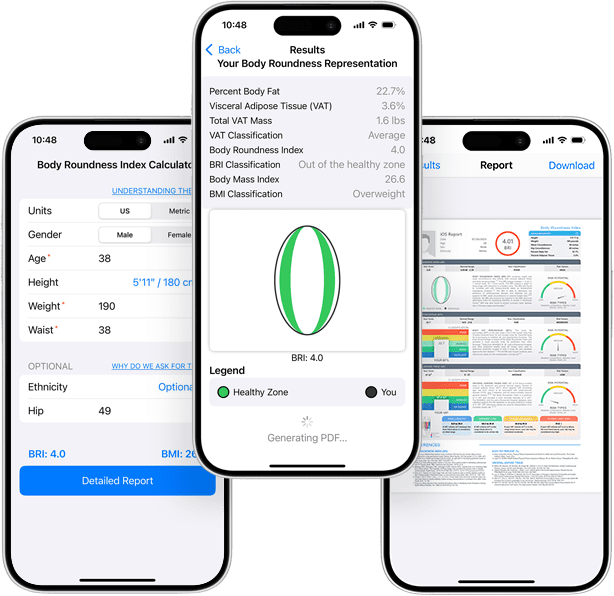
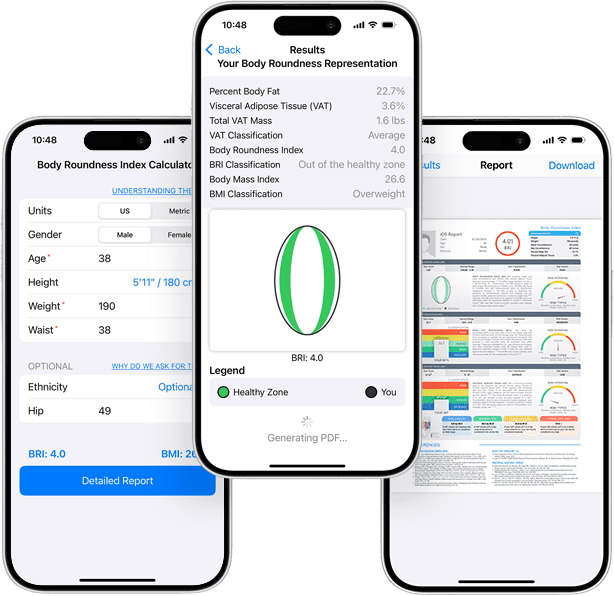
Our Body Roundness Index App gives you deeper insights than outdated BMI. With just a few quick measurements, you can understand your real health risks and see a clear picture of your body composition.
Easy-to-Interpret BRI Graphic
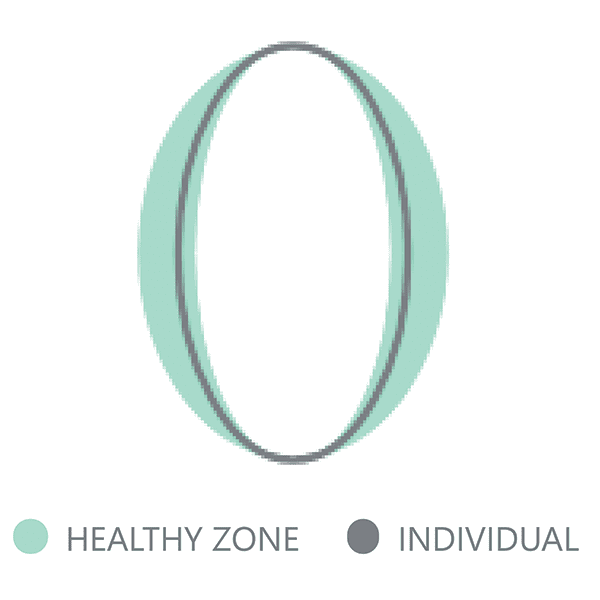
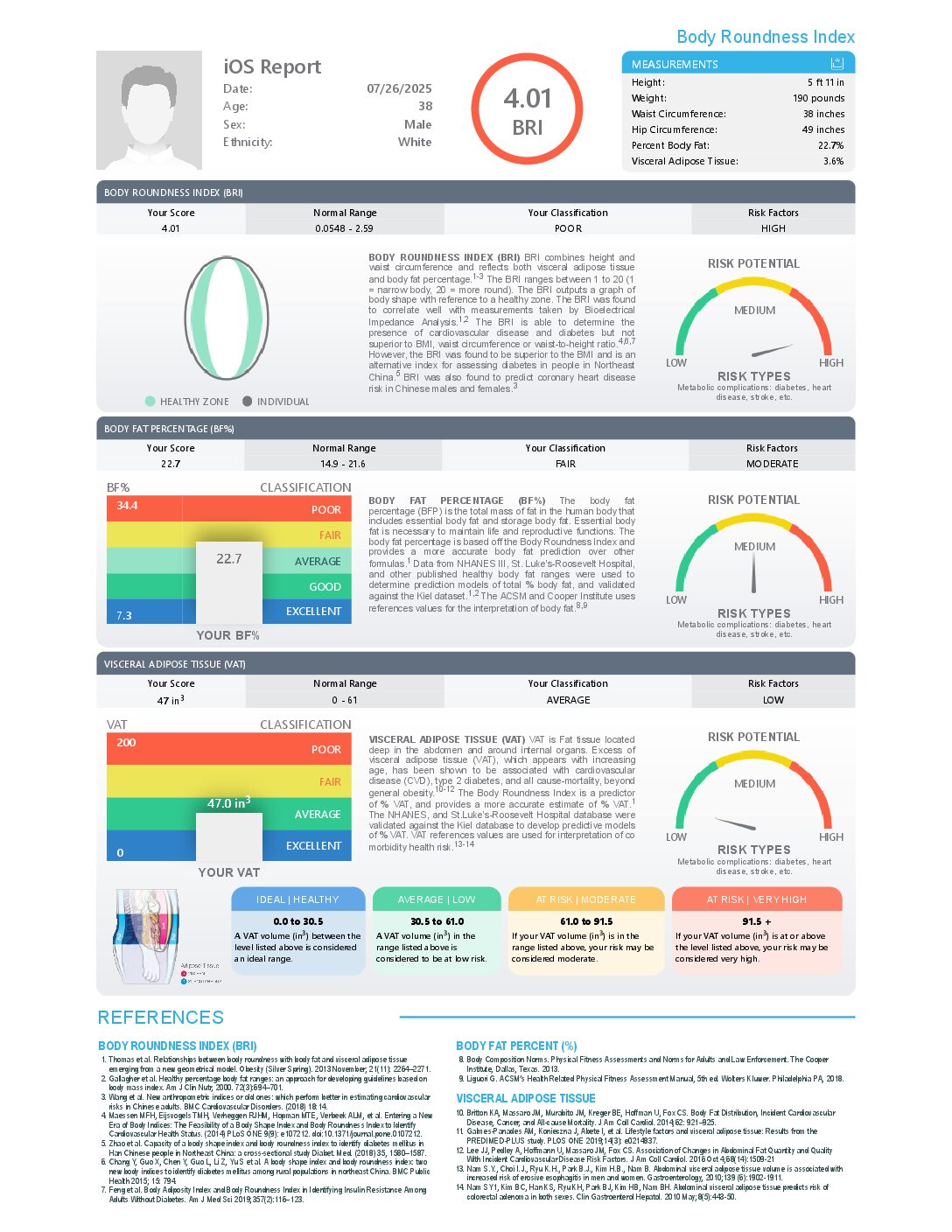
Instantly view your Body Roundness Index score in a simple, easy-to-read graphic. Compare your results to the healthy range and see exactly where you stand without complicated math.
Full-color Risk Assessment Meters*
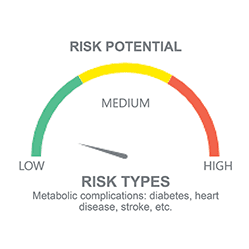
Quickly understand your potential risk for conditions like diabetes, heart disease, and stroke. The app’s clear meters show whether you are in the low, medium, or high-risk category.
Detailed Illustrations & Descriptions*
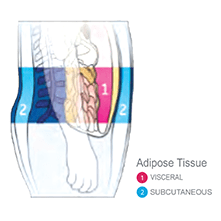
Learn why not all fat is the same. The app explains the difference between visceral fat around your organs and subcutaneous fat under your skin, helping you understand your true health risks.
Color Graphs Classify Your Results*
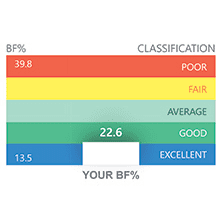
Stay motivated with progress tracking over time. Color-coded graphs classify your results from poor to excellent so you can easily see improvements as you make lifestyle changes.
For decades, BMI has been the go-to health number, but it was designed in the 1830s for population studies, not personal health. BMI ignores muscle, fat distribution, and body shape, which means a large part of the population are often misclassified.
The Problem with BMI
- Cannot distinguish between fat and muscle
- Misses dangerous belly fat that raises disease risk
- Mislabels millions of people as “healthy” or “overweight” incorrectly (like athletes!)
The Solution: Body Roundness Index (BRI)
BRI is a modern metric based on your waist size and height. It identifies visceral fat, the type of fat around your organs that strongly predicts heart disease, diabetes, and stroke.
What Makes BRI Better
- More Accurate: Closely linked with body fat percentage and real health risk
- More Inclusive: Works across body types, ethnicities, and ages without misclassification
- More Visual: Generates clear, easy-to-read graphics that BMI cannot match
Why It Matters for You
With BRI, you see your true health picture. It shows changes like shrinking your waist or reducing belly fat, even if your weight stays the same. This makes it more motivating, more personal, and more useful than BMI.
Take Control of Your Health
You don’t have to wait for healthcare systems to catch up. The Body Roundness Index App gives you instant access to your BRI score. Just measure your waist and height, enter them into the app, and see your health risks in seconds.
1. Considers Fat Distribution
BRI uses waist and height to reveal where your body fat is stored, especially around your belly. BMI only looks at weight and height.
2. More Accurate for Health Risks
BRI better predicts heart disease, diabetes, and stroke than BMI.
3. Personalized to Your Body
Your BRI score reflects your unique shape and risk profile. BMI applies a one-size-fits-all number.
4. Focuses on Central Obesity
BRI identifies abdominal fat, the kind most linked to serious health problems. BMI treats all weight the same.
5. Works Across All Populations
BRI is accurate for all ages, body types, and ethnic groups. BMI often fails due to demographic differences.
6. Doesn’t Confuse Muscle with Fat
Athletes and muscular people are often labeled “overweight” by BMI. BRI avoids this mistake.
7. Predicts Metabolic Syndrome Early
BRI is linked to early warning signs like insulin resistance and high blood pressure. BMI misses them.
8 Easy to See and Understand
The Body Roundness Index App gives you visual health charts you can actually read. BMI is just a number with no context.
9. Linked to Body Fat Percentage
BRI more closely matches actual body fat, making it reliable for weight management.
10. Modern, Research-Backed Tool
BRI is built on modern science and body modeling, not a formula from the 1830s.

Focuses on Fat Distribution
BRI shows where fat is stored, especially harmful belly fat around your organs that raises risk for heart disease and diabetes.
More Personalized
Your body is unique. Unlike BMI’s one-size-fits-all number, the Body Roundness Index App gives you a personalized health score based on your shape.
Better Predictor of Disease Risk
Studies show BRI is more accurate at spotting early risks like insulin resistance, cardiovascular disease, and metabolic syndrome.
Works Across All Body Types
BRI avoids the BMI mistake of labeling muscular or athletic people as “overweight.” It adapts to all ages, genders, and body types.
Tracks Fat Loss More Accurately
Waist size changes tell the real story of fat loss. BRI makes it easy to track progress beyond just the scale.
Supports Modern Wellness Goals
BRI aligns with today’s focus on fat loss, metabolic health, and overall body balance, not just weight.
Improves Health Awareness
By highlighting visceral fat, BRI helps you make smarter choices about diet, exercise, and lifestyle.
Complements Smart Health Tools
Pair your BRI results with fitness trackers and smart scales for a complete picture of health, including heart rate, activity, and sleep.
References:
“BRI … reveals hidden risk factors for heart disease, diabetes, and more”
Harvard Health: https://www.health.harvard.edu/staying-healthy/body-roundness-may-beat-body-mass-for-identifying-risky-fat
Verywell Health: https://www.verywellhealth.com/body-roundness-index-8755058
“Detect dangerous belly fat around your organs that BMI cannot measure”
Stanford Medicine: https://med.stanford.edu/news/insights/2024/11/bmi-body-mass-index-alternatives-science.html
Wikipedia (BRI background): https://en.wikipedia.org/wiki/Body_roundness_index
“Identify risks early for cardiovascular disease, type 2 diabetes, and hypertension”
Verywell Health: https://www.verywellhealth.com/body-roundness-index-8755058
Harvard Health: https://www.health.harvard.edu/staying-healthy/body-roundness-may-beat-body-mass-for-identifying-risky-fat
“Track your progress over time with visual health assessments”
Wikipedia (BRI as visual anthropometric tool): https://en.wikipedia.org/wiki/Body_roundness_index
“BMI cannot distinguish between fat and muscle”
Harvard Health: https://www.health.harvard.edu/staying-healthy/body-roundness-may-beat-body-mass-for-identifying-risky-fat
Stanford Medicine: https://med.stanford.edu/news/insights/2024/11/bmi-body-mass-index-alternatives-science.html
“BMI mislabels athletes (e.g., muscular people as overweight)”
Yale Medicine (Schwarzenegger case): https://www.yalemedicine.org/news/bmi-or-bri-how-to-assess-your-body-weight
“BRI identifies visceral fat, linked to heart disease, diabetes, and stroke”
Harvard Health: https://www.health.harvard.edu/staying-healthy/body-roundness-may-beat-body-mass-for-identifying-risky-fat
Wikipedia: https://en.wikipedia.org/wiki/Body_roundness_index
“BRI more closely linked with body fat % and real health risk”
NIH/PMC study: https://pmc.ncbi.nlm.nih.gov/articles/PMC3692604/
“BRI is more inclusive across body types, ethnicities, and ages”
Medical News Today: https://www.medicalnewstoday.com/articles/bmi-vs-bri-why-body-roundness-better-indicator-heart-disease-risk
Verywell Health: https://www.verywellhealth.com/body-roundness-index-8755058
“BRI predicts metabolic syndrome, cardiovascular disease, and type 2 diabetes better than BMI”
JAMA Network Open (mortality study): https://jamanetwork.com/journals/jamanetworkopen/fullarticle/2819558
NIH/PMC study: https://pmc.ncbi.nlm.nih.gov/articles/PMC7885560/
Lipid World (2025): https://lipidworld.biomedcentral.com/articles/10.1186/s12944-025-02450-8
“BRI introduced in 2013”
Wikipedia: https://en.wikipedia.org/wiki/Body_roundness_index
“Some institutions are phasing out BMI in favor of BRI”
UCLA Health: https://www.uclahealth.org/news/article/bmi-being-phased-out-favor-bri
“Optimal BRI range is about 4.5–5.5 (ideal health range)”
PopSugar (media coverage of BRI ideal range): https://www.popsugar.com/health/what-is-bri-49405295